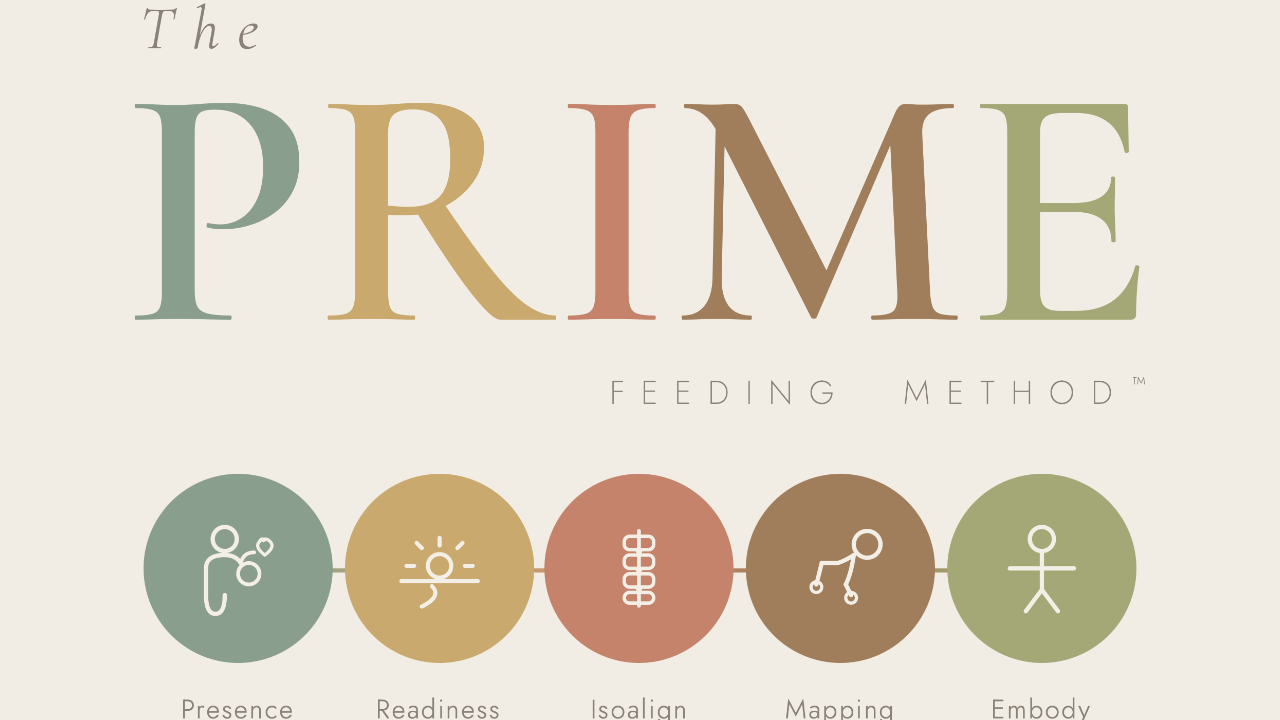
The PRIME
Feeding Method for babies
A full-day clinical masterclass for lactation consultants, physiotherapists, speech and language therapists, osteopaths, chiropractors, craniosacral therapists, midwives, and paediatric clinicians. Learn The PRIME Feeding Method™ and leave with a structured approach you can use in your next session.
The current model is fragmented.
The PRIME Feeding Method™ closes the gaps.
A lactation consultant addresses latch. A bodyworker addresses body tension. A speech and language therapist addresses oral motor function. A paediatrician addresses reflux. A physiotherapist achieves alignment. Each working within their own scope, with no single clinician holding the whole picture.
What tends to emerge is three consistent gaps. Feeding function is rarely observed. The infant's state is not optimised before clinical input. And the parent's nervous system is excluded from the treatment model entirely.
The PRIME Feeding Method™ is the clinical framework that closes all three. One coherent approach, applicable to any baby, across any feeding type, with or without a structural diagnosis.
Five elements. One coherent approach.
Each element is sequentially important and continuously present throughout the treatment episode. They are not independent: they interact, they influence each other, and they need to be held simultaneously even as you address each one in turn.
The goal of all five elements working together is for the baby to be PRIMED, D is for Default, a state where good feeding is no longer something they are working towards. It is simply what they do.
A framework you can use in your next session.
The neurobiological foundation
A working clinical understanding of The Polyvagal Theory (Stephen Porges) and how it applies to every infant feeding session, not as theory but as the basis for every clinical decision you make.
Clinical assessment across all five elements
How to assess each PRIME element in the room with a family. What to look for, what it means, and what to do about it in the right sequence.
The ACE tools in detail
FACE, PACE, and RACE: the Adaptive Coordination Exercises that form the practical core of Mapping. When to use each, how to select between them, and how to transfer them to the family.
Isoalign assessment and technique
How to assess postural alignment across the whole infant body, not just the oral cavity, and the specific techniques for resolving compensatory patterns before beginning oral motor work.
The PRIMED outcome framework
What PRIMED means as a clinical goal, how to recognise it, and how to have the discharge conversation in a way that empowers families rather than creating dependency.
Live Q&A with Kate and Justin
Direct access to two of the leading clinicians in infant feeding rehabilitation. Bring your cases, your questions, and your clinical challenges.
Default is not the absence of difficulty but the presence of capacity
Kate Roche
Two decades of clinical practice.
One framework.
Secure your place.
Registration is open now for the live virtual masterclass on 22 September 2026.
- Full day live virtual masterclass, 22 September 2026
- The complete PRIME Feeding Method™ clinical framework across all five elements
- Handout and reference materials
- Live Q&A with Kate and Justin throughout the day
- Certificate of attendance for your CPD records
- Access to course recordings for 30 days post-event
- Full day live virtual masterclass, 22 September 2026
- The complete PRIME Feeding Method™ clinical framework across all five elements
- Handout and reference materials
- Live Q&A with Kate and Justin throughout the day
- Certificate of attendance for your CPD records
- Access to course recordings for 30 days post-event
View the full running order for the day
When places are sold, a waitlist will open for the next cohort.
The day, session by session.
Tuesday 22 September 2026, 9am to 5pm Irish time, live on Zoom. As this is our first time bringing the masterclass online, we ask everyone to keep their camera on throughout the teaching sessions and to have a microphone ready for the discussion sections.
Certificate of attendance: each participant receives a certificate confirming the hours attended live, up to 6 hours of teaching, for their own CPD records. This course is not formally CPD accredited. Recordings: all registered participants receive access to the recording for 30 days following the course, for personal use only.
Any clinician who supports
infant feeding.
The PRIME Feeding Method™ is a feeding framework applicable to any baby, across any feeding type, with or without a structural diagnosis.
Anyone with clinical contact with families where feeding is challenging, with a desire to understand why, and what to do about it. This is for you.
Frequently asked
Coming Soon
Interested in attending in person?
We are planning an in-person cohort of The PRIME Feeding Method™ Masterclass for babies for early November 2026, based in Ireland.
Register your interest below and you will be the first to hear when dates and venue are confirmed.